I’m Leandro, and I design cool games and products. With a background in social psychology, I also do UX and game research. I love the process of designing amazing things for real people! I’ve been in this field since 2007.
Farm Heroes Saga is a game launched in 2013 with 50 million players around the world. As a UX Lead, my role was to create and execute the UX strategy to engage new players in the game. That included the creation of UX pillars and the redesign of the key systems that introduce the game to the new audience.
The Problem
Farm Heroes Saga is a game from 2013 with a loyal and engaged audience. However, the game was struggling to acquire new players. The main challenge of this project was to understand how we could modernise the game to be attractive to a new audience without hurting what makes it magical to our loyal players.
The Solution
I tackled the problem by planning and running several rounds of user research. Quantitative data showed where new players were dropping off, while qualitative research revealed why they weren’t engaging with the game.
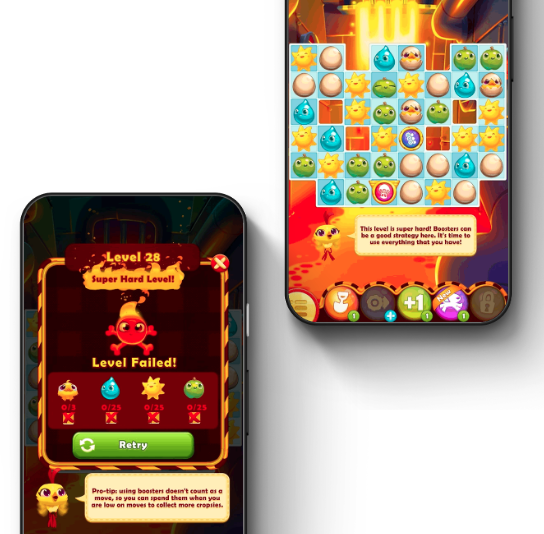
The data showed that the tutorials were a huge blocker: the learning systems had remained the same since 2013, while modern games had become far more dynamic in how they teach players. That insight led me to design a completely new approach to introducing the game’s mechanics.
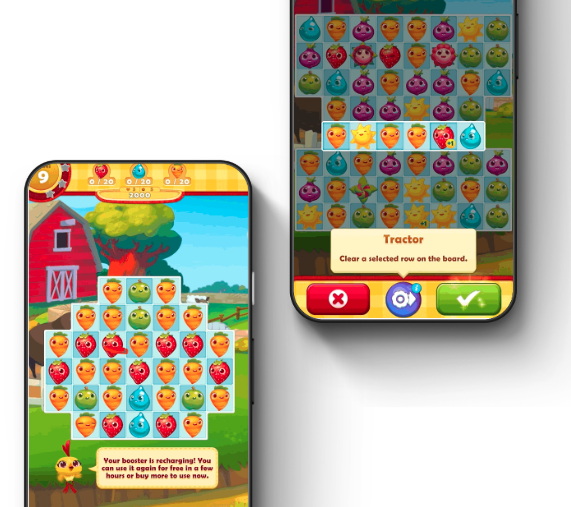
The new system followed a UX principle of “guided autonomy”: instead of dictating exact steps like the old tutorials did, it gave players basic commands and let them apply those commands however felt best, in safe, hard-to-lose levels. Exploring the game themselves helped players internalise its rules more easily, making learning far more meaningful, fun, and easy.
Impact
The onboarding system was so successful that it became the standardised way to introduce any new mechanic in the game.
Early game retention increased, and more players were finishing the first 100 levels of the game.
Research became a habit within the team. Within two years, we were running two UX research studies every month.
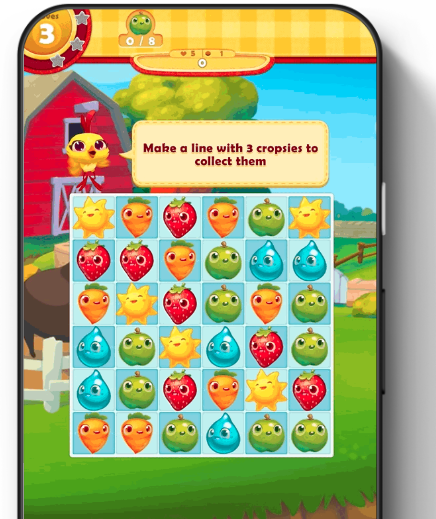
New learning system focused on player autonomy, giving them basic commands and the freedom to explore how they want to apply the rulesIn hard levels, the game does not force any strategy, but it indicates how to recover from a bad strategy when the player was losingTeaching about boosters was contextual: no big walls of text for players to memorise, just contextual information that helps players anticipate the consequences of their actions and strategise better
Google is a global company with hundreds of thousands of people working from offices spread all over the world. My role was to create tools to facilitate collaboration between Googlers in different offices and timezones.
The Problem
As a huge company with hundreds of thousands of employees, Google lacked a good way to foster collaboration between Googlers spread across the globe. This became critical during the pandemic, when people weren’t even sharing the same office.
I worked to tackle two main problems: “How might we help Google employees feel less disconnected and stressed while collaborating across timezones or working remotely?” and “How might we help team leaders and directors manage their teams without losing key information?”
The Solution
To improve the quality of communication among Googlers, I researched the types of messages shared across internal applications: where files were shared, where availability was communicated, and where team changes, like reorgs or new teams, were announced.
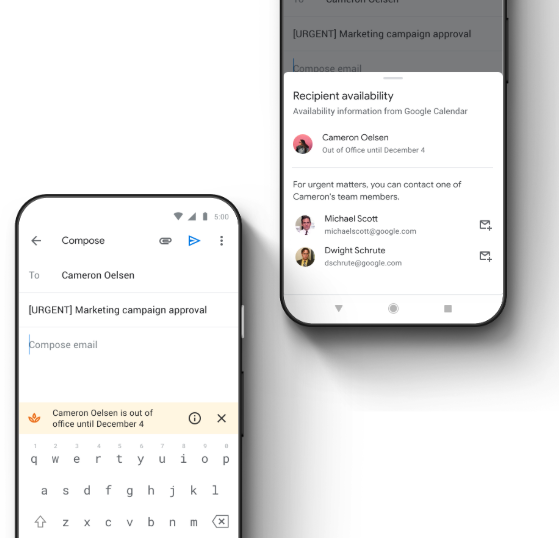
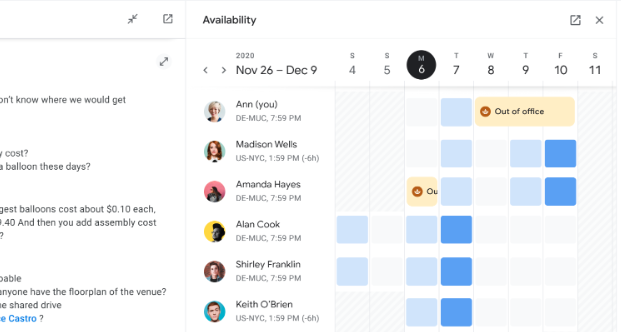
With that mapped out, I built communication systems integrated into employees’ day-to-day work. Chat and email signalled immediate availability, while the calendar showed where people would be on any given day. It also surfaced focus time and used AI to suggest the best alternative contact for urgent requests.
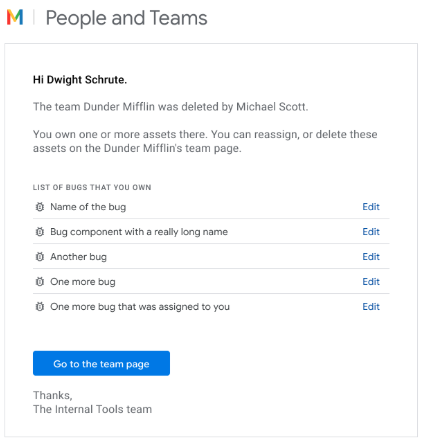
I also tackled asset management: teams often lost files, bugs, code, and team information when a member moved elsewhere in the company. I studied how team leads tracked that information and built tools that let reorgs happen without losing anything important.
Impact
Team availability stats were so well received that the Google Calendar and Gmail teams expanded them beyond internal use, and some of these features are now widely available.
Historical team data was preserved and easy to find, streamlining internal reorgs.
Helping team members find alternative contacts for urgent mattersHelping team leads understand the availability of all team membersKeeping team leads up to date with their team’s important assets during a reorg
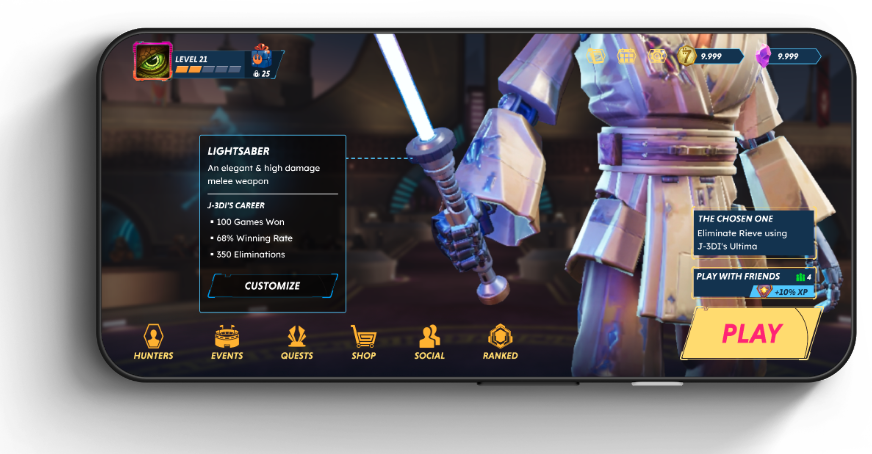
Star Wars is one of the most recognisable brands in the world. The game Star Wars: Hunters invited players from all around the globe to fight in exciting matches. My role was to lead the UX Team in building meta-game features that immerse the player into the Star Wars universe.
The Problem
Star Wars: Hunters was an engaging shooter that invited players from around the world to fight exciting matches for the glory of being recognised as the best Hunter in the galaxy.
Despite the exciting gameplay, the meta layer lacked interactivity: it felt like a series of mandatory steps players had to follow. The challenge was to make that layer just as engaging as the matches themselves, and to increase the number of players starting a match.
The Solution
Through UX research, I found the main problem with the meta game’s design: the time to engage was too long, requiring players to go through a variety of screens and make several decisions just to start one match.
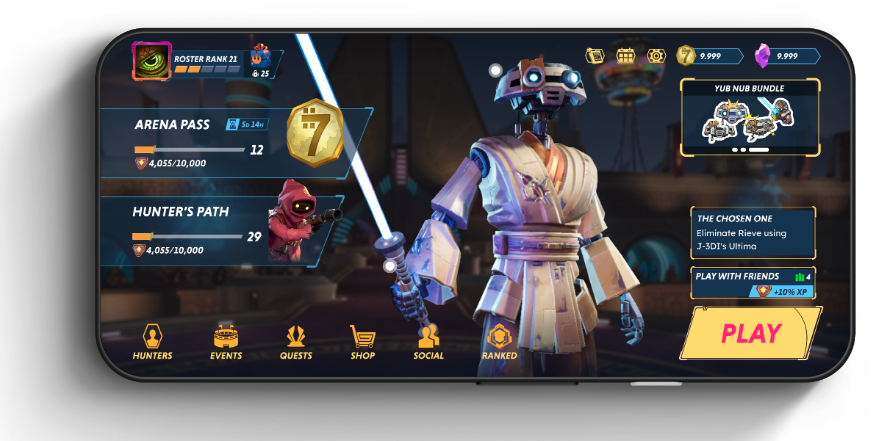
The first solution was reducing that time by making the Play button available everywhere. The principle was simple: no matter where you are, you can always start a match.
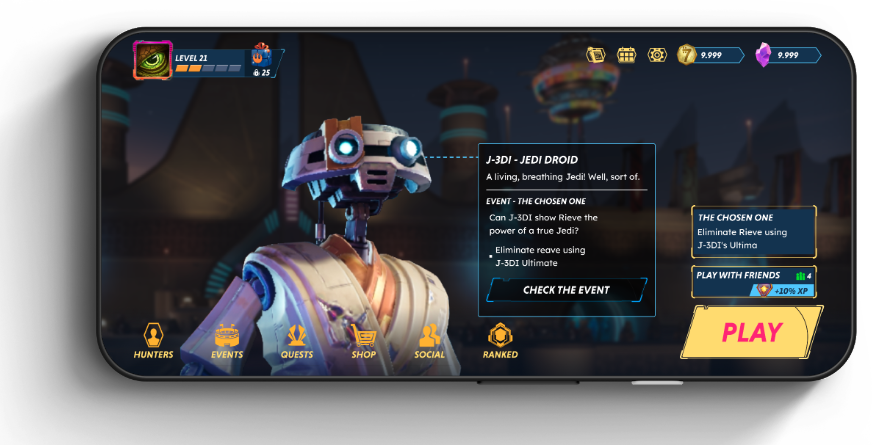
The second solution was not about rushing players into a match, but making the meta layer itself inherently fun: fun interactions, narratives, and choices that made players feel like they were already playing with every interaction. Building a character, selecting a hero, and learning about their abilities and backstory all put players in a fun mental state even before a match began.
Impact
Players felt more engaged with the meta layer and demonstrated more curiosity to learn about the characters.
Characters started to have more meaning to players.
During research, players demonstrated having fun exploring different character builds and learning about different playstyles.
Redesigned home screen, highlighting characters that players loved, a mission connected to each character’s backstory, and an always available Play buttonHelping players immerse themselves in the character’s narrative by letting them interact with the character on the app’s main screenWhile learning more about the character’s narrative, players also learn more about their weapons and builds
Designing prototypes and flows that meet people’s needs, feelings, and aspirations when they interact with products and games.
Usage of AI to Accelerate UX
Ability to integrate AI into the UX Design process, accelerating the steps of validating ideas and conducting research.
A/B Testing
Quickly validating design decisions through A/B testing. Deep knowledge of different A/B testing techniques.
Quantitative UX Research
Planning research from scratch and analysing behavioural and attitudinal data using the appropriate techniques, such as conjoint analysis, chi-square, ANOVA, regression models, etc.
Qualitative UX Research
Applying methods, such as ethnography, interviews, discourse analysis, content analysis, and so on, to generate insights about how people perceive and think about games and products.
Internal Products
Designing internal products focused on improving people’s productivity, decision-making processes, and well-being.
Cross-functional Collaboration
Evangelising UX to non-UX people and onboarding non-UXers to become an active part of the UX process.
Strategic UX Leadership
Defining long-term goals, building effective UX roadmaps with short-term actions connected to important UX and Product KPIs.
Games Research
Planning and facilitating playtests, using both quantitative and qualitative methods. Creating high-quality reports that help a game team understand the weaknesses and strengths of a game.
Game Design
Creating engaging game rules, systems, economies, and levels, always focused on delivering a positive and engaging game experience.
Gamification
Applying game design principles to product design, creating engaging features for customers.
UI Design
Planning interfaces and Design Systems focused on creating outstanding and effective communication channels between humans and systems.
Workshop Facilitation
Fostering collaboration, regardless of whether teams are remote, local, or hybrid. I use techniques to engage a diverse group of people in solving problems and brainstorming solutions.
People Management
Leading product and game teams by keeping team members engaged and motivated in their work. This includes leading without micromanaging and giving support for career growth.
Public Speaking
Speaking at conferences about UX, Games, Psychology, and Research. It also includes giving training sessions and organising classes for UX professionals at different levels.
2026 – present
Next – Netflix Games
Senior UX Designer and Researcher
Planning new puzzles for the game Netflix Puzzled. Designing systems focused on delighting players and on its optimal usability. Conducting weekly User Research to understand the needs of puzzle players.
2021 – 2024
King
Principal UX and Researcher
Hands on UX Leadership and UX Research at the game Farm Heroes Saga. Established a UX and Research culture in a game with millions of players around the world.
2019 – 2020
Klarna
Sr Product Designer
Built a Shipping Service, making sure deliveries do not get lost in transit due to wrong user information.
2010 – 2017
PopUp Design
Founder & UX Design
Founded a UX agency focused on providing UX Research and UX Design services. Worked on more than 100 projects in 6 different countries.
2011
SAGA
Design Teacher
Worked as a teacher at SAGA (School of Arts, Games, and Animations), a Brazilian Design school.
2007 – 2009
Freelancer
Designer
Digital and graphic design for various clients in Brazil.
2024 – 2026
Zynga
Lead Experience Designer
Led the UX team of the game Star Wars: Hunters, and the UX Design of an unannounced mobile shooter. Responsible for creating UX Pillars and Principles, and researching to understand more about players’ needs and attitudes.
2020 – 2021
Google
Interaction Designer
Embraced the mission of organising the information of the world. Worked on productivity tools for Google Suite users.
2016 – 2019
Booking.com
UX Team Lead
Led the team who built the Genius programme, growing the product to 80M travellers around the world.
2015 – 2016
Red Ventures
Team Lead & Sr UX Designer
Led the UX team of a product focused on customer acquisition. In one year, we increased the number of customers of our main client by 100%.
2009 – 2011
Casa Rosada
Webdesigner
Webdesign and Front-End development at the Brazilian Marketing Agency Casa Rosada.
TALKS ANDKEYNOTES
I can talk about UX and Psychology, Research Methodologies, Design Theory. Are you organising a UX Design or Game Design event? Reach me out if you are interested in a talk.
COACHINGAND COURSES
I offer 1:1 coaching sessions and trainings in UX, User Research and Game Design fields. If you are interested in hiring a training for a group, please reach me out for a quote.
User-focused Design Leader with experience designing global products, internal products, and mobile free-to-play and live-service games. Currently, I work as a UX Designer and Researcher on the game Netflix Puzzled, establishing design best practices and fostering a culture of understanding users’ aspirations. Previously, I led the UX and Meta-Design team at Zynga, owning game loops, economies, and progression systems that lifted engagement and revenue while staying fun and fair.
In the past 20 years, I led multi-disciplinary design squads for games and live digital products. As a Leader, I’ve mentored designers in systems thinking and mixed-method research, defined growth-driven design strategy, and established quality bars through clear principles, values and vision. I also worked on upscaling Design teams by defining job descriptions and hiring strategies.
Strategic UX Leadership · Quantitative UX Research · Games Research · UX Design · Game Design · Gamification · UI Design · Qualitative UX Research · Workshop Facilitation · People Management · Public Speaking · Strategic UX Leadership · Quantitative UX Research · Games Research · UX Design · Game Design · Gamification · UI Design · Qualitative UX Research · Workshop Facilitation · People Management · Public Speaking ·